
A dusty little corner of the Internet: electronics, computer hardware and software, general aviation, 1980's Mopars, and related sundry.
Automotive
 Up until around 2016 or so, I primarily drove these quirky "Turbo Mopars" employing Chrysler's 2.2L turbocharged powertrain. My last daily driver of this type was a 1986 Dodge Daytona Turbo Z C/S. The car was a bit of a basket case when I got it, but it was eventually sorted out: the frame was straightened, the floor pans replaced, and the powertrain and interior were upgraded. It was a very fun and comfortable car to drive (for a Turbo-Mopar anyway). Eventually I had to let it go, as it just wasn't practical to use a 30+ year-old car as a daily.
 My previous daily driver from 1995 through 2002 was a 1988 Dodge Shadow ES. It was laid to rest due to a fatal case paint peel and floorpan/frame rust. It had been in a few collisions over its life and it just wasn't worth saving. Prior to that, I drove a 1987 Dodge Shadow Turbo and a 1987 Plymouth Sundance Turbo. I had a thing for these particular cars (the "P-body", in Turbo-Mopar parlance), especially the first generation (1987-1988).
 Back when I first graduated from college, I strongly desired the ultimate first-generation P-body: the 1987 Shelby CSX. After some searching and waiting for the right car in my price range, I found Shelby CSX #694 of 750. It has mainly been a project car, though it has had to step in as a daily from time to time. This is the last of these cars that I still own.
Chrysler had an interesting relationship with Carroll Shelby in the late 1980s. While the resulting vehicles were never taken very seriously in muscle car circles, a great online community did form around them. The discourse has moved from mailing lists to online Forums to (unfortunately) Facebook Groups, but the community itself still exists. The Shelby-Dodge Auto Club still holds an annual convention to this day.
In the dark recesses of the Internet lies an ancient tome of knowledge that (according to the server logs) people still visit for some reason: Mini-Mopar Resources.
The Daytona: November 24, 2003
Posted on November 24, 2003.
 Got the driver's side welded in. I didn't do quite as nice a job forming this sheet. I sort of got it close, tacked it in and beat the crap out of it with a large sledge hammer to form the front of it to the weird shape of the floor pan around there. I also did not try to reproduce the channels like I did on the passenger side. I did kink a couple of diagonal dents with a cold chisel and hammer on the right portion to keep the panel from wobbling.
The Daytona: November 17, 2003
Posted on November 17, 2003.
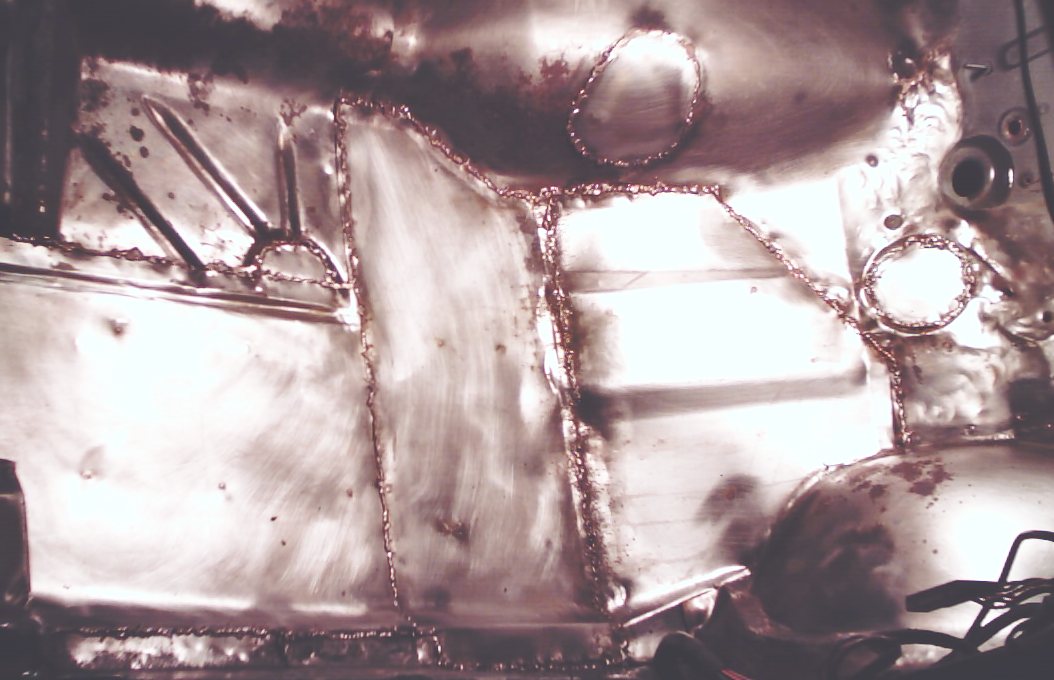 Progress has been slow but steady on the floorpans. The passenger side is welded back in. I ended up getting a MIG welder, as it is the only way to do sheet metal (short of TIG). It definately makes the job much easier and better-looking than trying to do it with a stick welder (less cleanup). I did get one of those stitch welders off of eBay for $20. For stick welding small stuff, it really does help. The rod doesn't stick to the piece and you don't have to worry so much about burn-though. Before welding the plates in, I painted the frame rail and the bottom of the plates with POR-15 Chassiscote Semigloss Black. I have had good luck with POR-15 in the past, but this will be the real test. Obviously, I had to take a wire wheel to the places that I welded the plates to the frame because the paint was burned away. I will go back and touch those up. Also, I won't be using the semigloss stuff again. The finish is very random with using a brush to apply it. Spraying it probably works better.
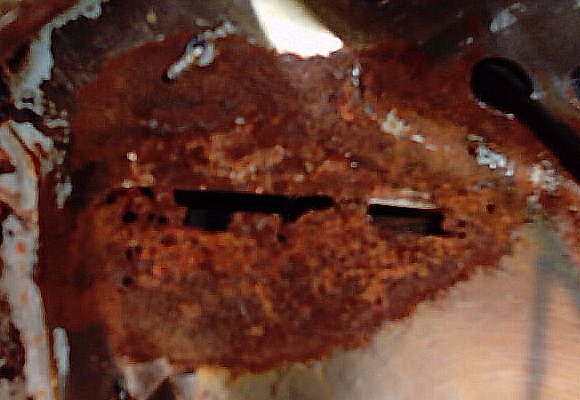
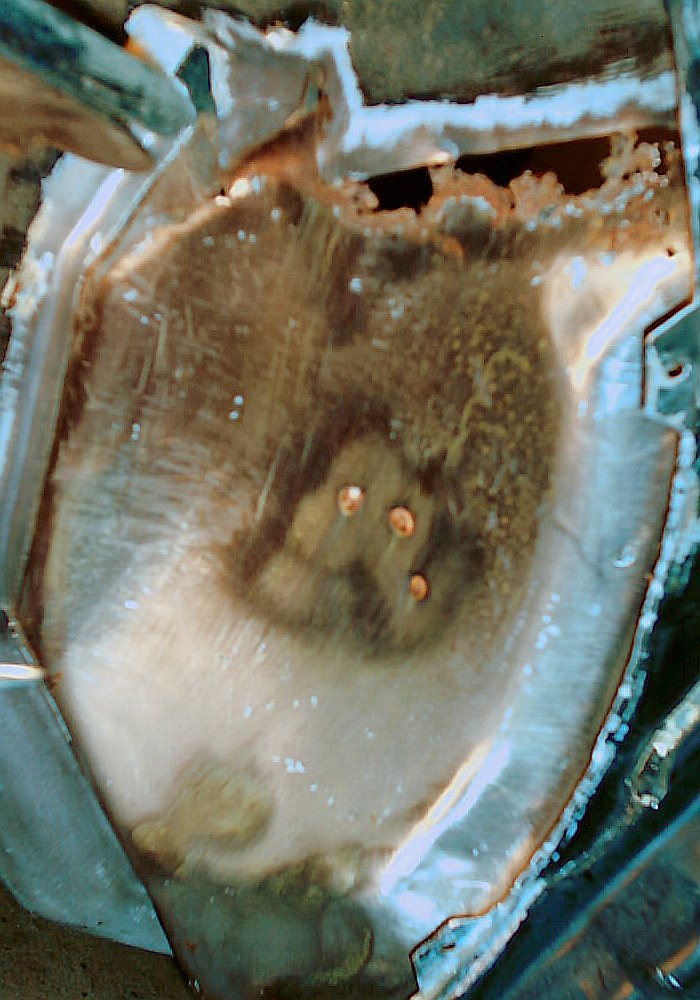
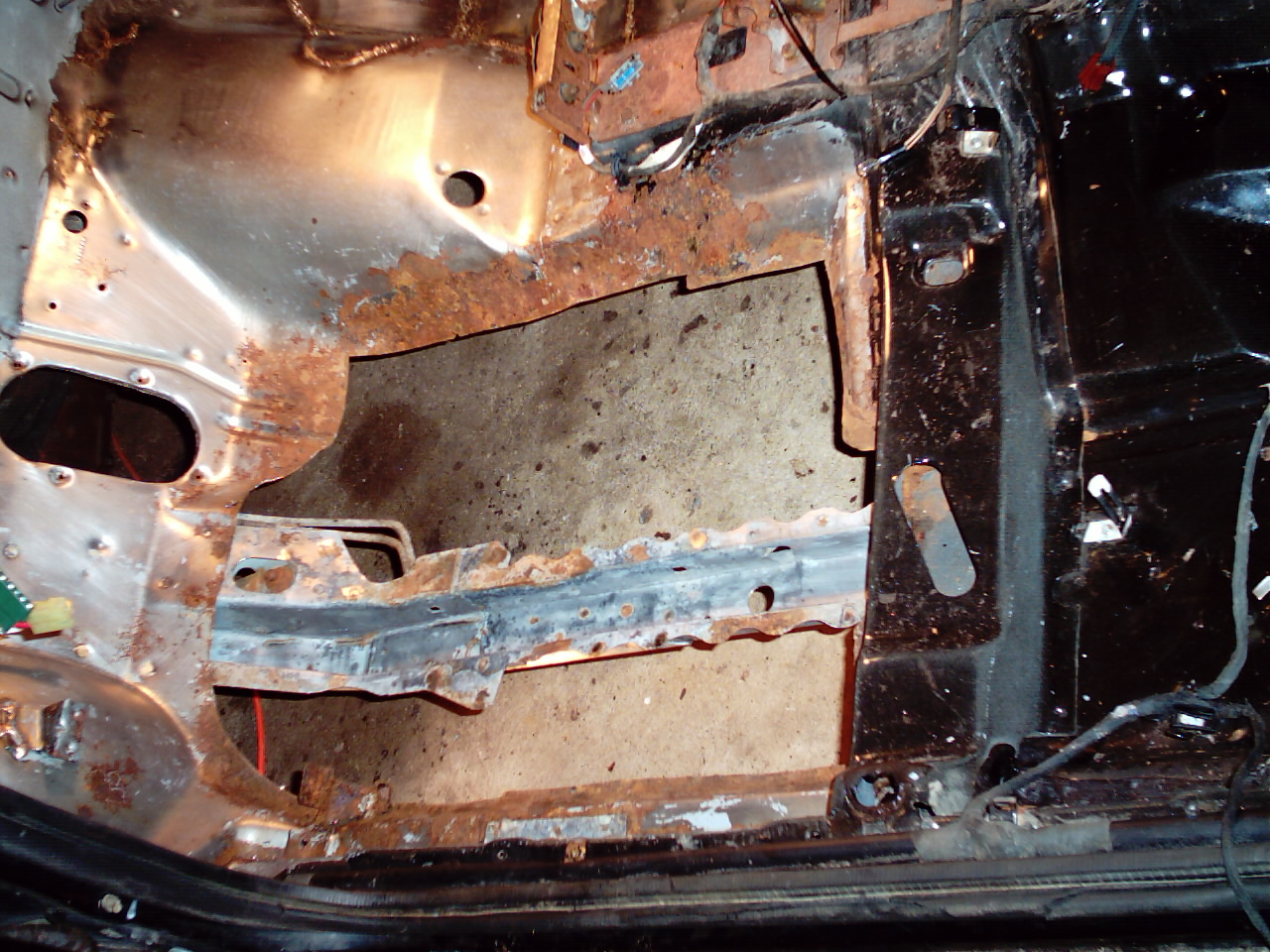 The driver's side is out and the paint stripped. I was disappointed to find the rear K-frame mount on that side is bent as well. This one is bent down instead of up. Even so, I was unable to straighten it. I may give it one more shot with brute force (dropping the car on a jack stand) before welding, though. That's the only way I've ever been able to straighten heavy gauge frame rail steel in the past. Also, the driver's side fender is rusted out pretty bad at the top where it meets the firewall. This area is prone to rust on these cars if it has ever been in an accident. The body caulk cracks and then water, salt and debris gets packed into the seam by the wheels. The passenger side is rusty too, but still solid. If you see any cracks in the body caulk from the fenders, make sure the inside doesn't look like this:
The Daytona: October 14, 2003
Posted on October 14, 2003.
Well, the car has pretty much been sitting all summer. I spent most of it working on the house and yard, but I do now have 60A service to the garage. I also have a compressor and a stick welder. I just hope I get the paint on the car before the weather turns cold. I have a heater, but I don't dare use it while painting.
I started getting serious with the floorpans a few weeks ago, but then work sent me out of the country for two weeks. I now have all the rotted sheetmetal out of the passenger side (ended up being most of it). The damage from the previous owner's incident with the pothole is quite extensive. Much of the floorpan and firewall on that side is buckled and cracked, which is what caused it to rot out. The frame rail was pushed up and outwards, but remained completely rust-free. Apparently, the impact to the front of the K-frame, caused the K-frame to "pivot" on its front mount and mash the rear mount up and back. Quite franky, the car isn't worth fixing, but it is too late for that now. I managed to push the frame rail back down and over somewhat. The position of the rear K-frame mount still isn't right, but I think it is closer to where it should be. I bent some really huge 2" angle iron and plate steel trying to straighten the thing out. I will compensate by shimming down the K-frame on that mount and hogging-out the stud hole to give me more freedom. Hopefully it will be enough. The right-front K-frame mount is squashed and only partially connected to the frame rail, but it is accessible enough to fix. Right now, I am stripping the paint off of the remainder of the floorpan and rail so that I can paint everything with POR-15. The last thing I want is to have all this work rust-out on me. If the car still shakes under acceleration after all this, I will be really pissed.
The CSX: October 14, 2003
Posted on October 14, 2003.
Well, I spent much of the summer working on house and yard related things, so the Daytona sat for a long time. As such, the CSX has been my daily driver all summer and probably will be all fall. On the upside, some of that work included running 60A service out to my garage, which allows me to power my recently aquired compressor and stick welder. Hopefully I can get the Daytona back together in time to get the CSX back in the garage before winter.
On a whole, the CSX has held up well. There seems to be a coolant leak coming from the radiator. The radiator has desperately needed recoring since I got the car. I have also been using a custom calibration in place of the ND Performance cal I had before. It is much improved, though still has idle issues. The ND cal would always die two or three times at cold startup, but would eventually get going. It also would break up real bad around 5000rpm and had a part throttle lean spot around 10psi of boost that would cause the engine to cut-out. Aside from the idle problem (which may be mechanical), the new cal has none of these problems. It seems that I have the mixture setup right, but we shall see how my gas mileage is. See my Automotive Electronics pages for more info.
The Daytona: May 30, 2003
Posted on May 30, 2003.
I got the rear brakes put back together, finally. I originally took them apart to try to fix a squealing problem back there. I believe it was due to a broken spring on one of the brake shoes. I also wanted to bleed the brake system and flush it out with new fluid. Even though the brakes and lines are suprisingly unrusty, the bleeder on the left side snapped off. After breaking an extractor trying to get it out, I just replaced the cylinders on both sides (less than $10 each :). Of course, the flare nuts were frozen to the brake lines (which weren't even rusty), but I was able to spin the cylinder off the nut. On the right side, the grease around outer bearing was contaminated with water and grit and the spindle nut was even rusty. The dust cap seems OK, so I just flushed out all the grease with gasoline and repacked the bearings. The races looked fine, so I didn't bother replacing anything. Some new brake hardware and grease seals later, it was all back together.
I always like to get into everything on a new (ha!) car to get a handle on where things are. The shoes themselves seemed new and I know the front pads are new, so I should be good in the brake department. Another thing that I thought was odd was that the emergency brake cables are NOT frozen! The car is an automatic, so I doubt they were ever used. For whatever reason, these cables are plastic-coated. All of the '87 Daytonas and Shadows I've seen were just steel and would rust within a year or two, while my '88 had the coating. This car gets weirder and weirder.

