
A dusty little corner of the Internet: electronics, computer hardware and software, general aviation, 1980's Mopars, and related sundry.
Automotive
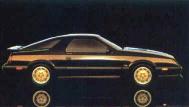 Up until around 2016 or so, I primarily drove these quirky "Turbo Mopars" employing Chrysler's 2.2L turbocharged powertrain. My last daily driver of this type was a 1986 Dodge Daytona Turbo Z C/S. The car was a bit of a basket case when I got it, but it was eventually sorted out: the frame was straightened, the floor pans replaced, and the powertrain and interior were upgraded. It was a very fun and comfortable car to drive (for a Turbo-Mopar anyway). Eventually I had to let it go, as it just wasn't practical to use a 30+ year-old car as a daily.
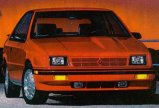 My previous daily driver from 1995 through 2002 was a 1988 Dodge Shadow ES. It was laid to rest due to a fatal case paint peel and floorpan/frame rust. It had been in a few collisions over its life and it just wasn't worth saving. Prior to that, I drove a 1987 Dodge Shadow Turbo and a 1987 Plymouth Sundance Turbo. I had a thing for these particular cars (the "P-body", in Turbo-Mopar parlance), especially the first generation (1987-1988).
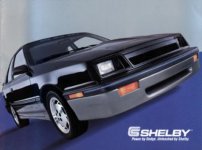 Back when I first graduated from college, I strongly desired the ultimate first-generation P-body: the 1987 Shelby CSX. After some searching and waiting for the right car in my price range, I found Shelby CSX #694 of 750. It has mainly been a project car, though it has had to step in as a daily from time to time. This is the last of these cars that I still own.
Chrysler had an interesting relationship with Carroll Shelby in the late 1980s. While the resulting vehicles were never taken very seriously in muscle car circles, a great online community did form around them. The discourse has moved from mailing lists to online Forums to (unfortunately) Facebook Groups, but the community itself still exists. The Shelby-Dodge Auto Club still holds an annual convention to this day.
In the dark recesses of the Internet lies an ancient tome of knowledge that (according to the server logs) people still visit for some reason: Mini-Mopar Resources.
The CSX: October 19, 1999
Posted on October 19, 1999.
A few more weird things happened lately. First the long, steel fuel line on the fuel rail cracked at one of the bends, causing the rail to depressurize when I accelerated. Then I started getting very bad hesitation. it got to the point where the engine would not even want to run under any load, then would suddenly be fine. Turned out to be the ignition coil mounting bolt, which was stripped out. Now all is good and the car is flying.
The next thing that needs attention is the tires. There appears to be flat spots from a 4 wheel lockup (panic stop). It has been doing this since I bought the car. I'm not sure if the tires can be salvaged, but the vibration is very annoying at high speeds.
The Shadow: October 12, 1999
Posted on October 12, 1999.
This past weekend I straightened out the subchassis and fixed a few broken items. These include the oil pressure light switch and the oil filter, which got whacked by the radiator fan motor and shroud when the subchassis got pushed back. Our handy-dandy hydraulic kit saved the day again. It's just a basic narrow cylinder with various extensions and ends so that you can stick it anywhere. Works great for separating ball joints, too. Anyway, I got the subchassis back where it should be and straightened out. I also fixed the grille brackets, headlight bowl/bezel, and fender. What is left of the grill is back in place and the headlights will be fixed as soon as I get some new alignment screws. If I can't find a grille, I may just patch-up this one and use it. It doesn't look great, but it will get me through the winter. What I really need is a hood...I cannot save this one.
In light of the hood bulge rarity, I may just put the T1 radiator from the CSX back into the Shadow and either convert back to T1 or use the Conquest intercooler setup. This would put the CSX back the way it was and allow me to use a flat hood on the Shadow. I like the look of the bulge hood, but it isn't absolutely necessary. I'm not sure that the Conquest intercooler is any better than the stock T2 unit. It's longer than the T2, but doesn't have any fins in the tubes (they are just flattened round tubes). Flow may be a bit better (maybe), but I think efficiency is questionable. Also, the CSX doesn't have A/C, so air flow to the stock IC in the stock location should be better than it is on the Shadow. I'm probably going to keep the BOV on the Shadow since it has the little Mitsu turbo.
The CSX: October 12, 1999
Posted on October 12, 1999.
For the first time in a while, less bad news. :) I finally got the Conquest intercooler installed last week. I found some 90-degree 2-1/8" I.D. hoses for the connections under the front cross member. I found them at Trak Auto for some kind of Ford van. The rest of the plumbing consists of mandrel-bent and straight exhaust pipe. The turbo-to-intercooler run is two 2" mandrel bent pipes and some straight hose. The intercooler-to-throttle body run is two 2-1/4" mandrel bent pipes and a long 2-1/4" straight pipe. All connections were made with bits of truck radiator hose and many stainless hose clamps.
Now that this car is intercooled, I return boost control back to the logic module. So now the 16psi ND computer can do it's thing. No more pinging at 13psi either. While I was at it, I relocated the MAP sensor to the firewall right next to the brake booster. I made an aluminum heat shield to protect the sensor and solenoids from the turbo. I took great care in replumbing the vacuum lines such that critical sensors will not be effected by other vacuum devices. These include the MAP sensor and fuel pressure regulator. Now the funky fuel curve problem is gone.
The setup worked great for about a week until I started getting problems where the engine would QUIT just as I would start to accelerate. I also noticed an erratic idle speed. I have have always had a code 15, so I just unplugged the frickin' speed/distance sensor--problem solved. I don't have cruise, an automatic, or electronic speedometer, so the usefulness of the sensor is questionable anyway.
In other news, the piston slap is as bad as ever and the engine is consuming oil, though I don't notice any smoke or smell at all, nor do I see any in the coolant, etc. I loose about a quart every 1000-2000 miles. I'm sure it's just the rings. Blow-by is horrible...the dipstick isn't blowing out, but it is very tight in the tube. Oil is coming out of the oil cap and it just recently blew some RTV out of the valve cover seal. Due to the Shadow's current condition, the Shelby is now my daily driver. I hope it holds up....
The Shadow: October 4, 1999
Posted on October 04, 1999.
Well, it appears that my luck has run out with this car. I was traveling about 35-40 mph (in a 50 mph zone) on a dark back road near my house when a deer jumped out of the tall corn field from the left right in front of me. I slammed on the brakes and swerved to the left hoping to avoid it (it was already more than half-way across). The result was the right corner of the hood and grill caught the deer in the rear in mid-air and flipped it into the right shoulder. My hood, grille, and headlight took most of the hit, but not before it bent back the subchassis behind it. The right fender was also bent outward, but easily recoverable. The big problem is finding an '87 or '88 P-body hood with a turbo bulge. I need the bulge to clear my upper intercooler hose and radiator fill cap (T2 unit). I saw a 4-door version of my car (red and all) in a yard. Unfortunately, the car and hood/grille is gone. If you know where I can find one, please let me know.
The Shadow: September 27, 1999
Posted on September 27, 1999.
I finally solved the last of the annoying boost gremlins on this car! I had yanked the Bosch BOV setup on the upper intercooler hose and replaced it with a stock T2 ribbed upper hose. I have bad boost stacking without the BOV (very bad for this little turbo), but no more boost drop-off or random boost amounts. Even though I have already tried removing the BOV and plugging the hole with a piece of wood, I wanted to dump this setup anyway. First of all, I don't like using that crazy setup with the two restrictors, check valve, and bleed to keep pressure on the BOV to keep it shut. Second, I know that my IC has quite a pressure drop at high boost, so the BOV would probably be more effective on the lower IC hose. Since I am not running more than 14psi (nor do I plan to), the stock BOV is perfect and it will also serve as protection because it will blow off the seat above 15psi in case something goes wrong with boost control.
So, I fabricated a new hose connection on the lower stock hose by cutting out a small section and putting a 1-1/2" copper drain pipe in its place (the stock lower IC hose is 1-1/2" ID). I opted for copper because it was easy to solder on a 3/4" fitting to attach the BOV hose. It's a 3/4" copper T-fitting that I sliced along the back and spread open to match the curve of the big pipe. It took some bending, hammering, and patience, but it worked. I then used a short piece of 3/4" copper pipe in the fitting to connect the hose to. I connected the BOV to the copper pipe in the fitting with a short piece of 3/4" I.D. heater hose and then to the air box with another piece. I already had a 3/4" copper pipe fitting on the airbox, so I just put a short piece of 3/4" copper pipe in it to serve as a reducer. The Bosch BOV used 7/8" I.D. hose, so the 3/4" fittings (not 3/4" pipe) were the perfect O.D. I squeezed the fittings so the pipe would fit tightly, sanded the surfaces, and then RTVed them in place. I didn't want to solder so that I could switch back easily. The setup works wonderfully and for the first time, my boost is predictable and solid! This car SCREAMS!!!

