
A dusty little corner of the Internet: electronics, computer hardware and software, general aviation, 1980's Mopars, and related sundry.
Automotive
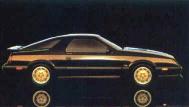 Up until around 2016 or so, I primarily drove these quirky "Turbo Mopars" employing Chrysler's 2.2L turbocharged powertrain. My last daily driver of this type was a 1986 Dodge Daytona Turbo Z C/S. The car was a bit of a basket case when I got it, but it was eventually sorted out: the frame was straightened, the floor pans replaced, and the powertrain and interior were upgraded. It was a very fun and comfortable car to drive (for a Turbo-Mopar anyway). Eventually I had to let it go, as it just wasn't practical to use a 30+ year-old car as a daily.
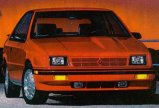 My previous daily driver from 1995 through 2002 was a 1988 Dodge Shadow ES. It was laid to rest due to a fatal case paint peel and floorpan/frame rust. It had been in a few collisions over its life and it just wasn't worth saving. Prior to that, I drove a 1987 Dodge Shadow Turbo and a 1987 Plymouth Sundance Turbo. I had a thing for these particular cars (the "P-body", in Turbo-Mopar parlance), especially the first generation (1987-1988).
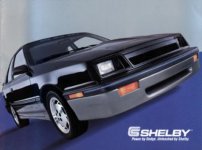 Back when I first graduated from college, I strongly desired the ultimate first-generation P-body: the 1987 Shelby CSX. After some searching and waiting for the right car in my price range, I found Shelby CSX #694 of 750. It has mainly been a project car, though it has had to step in as a daily from time to time. This is the last of these cars that I still own.
Chrysler had an interesting relationship with Carroll Shelby in the late 1980s. While the resulting vehicles were never taken very seriously in muscle car circles, a great online community did form around them. The discourse has moved from mailing lists to online Forums to (unfortunately) Facebook Groups, but the community itself still exists. The Shelby-Dodge Auto Club still holds an annual convention to this day.
In the dark recesses of the Internet lies an ancient tome of knowledge that (according to the server logs) people still visit for some reason: Mini-Mopar Resources.
The CSX: January 18, 1999
Posted on January 18, 1999.
Well, I received the adjustable fuel pressure regulator from Rick Diogo. It is actually for an '89 or later turbo, but it will work just fine the and pipe connection opens up the option for a custom fuel setup. It appears to be a used unit that has been modified. An aluminum cap with the hose barb and adjustment bolt covers what is probably a cut open, stock regulator. Better than hacking and gluing with JB Weld, or crushing it in a vise, in my opinion. :) I also received the pressure isolators I ordered for the oil and fuel pressure guages that I will be installing. They look like they will do the job and I will add specifics on how to get them to the Mini-Mopar Resource Site when I get the chance. I also updated this page with a picture of the pistons and rods I used on the engine rebuild. I actually had several pictures of the rebuild, but my nice camera and the roll of film they were on met their demise while I was on vacation in December. I am annoyed.
Since it cold outside these days and the CSX is buried in a foot of snow right now, I haven't done much with it. The old battery also decided that it doesn't like cold weather and has died. I don't want to drive this car through the salty roads of a mid-west winter anyway, so it will stay where it is until spring. I will then buy a new battery, install the goodies I have been collecting, and hopefully continue the restoration if I can. I can't wait to get that ND Performance logic module in there!
My future with this car is becoming uncertain at this point because of certain events going on with my life. I hope I will be able to keep it after all this work and years of waiting to finally get one. Keep your fingers crossed for me....
The CSX: December 1, 1998
Posted on December 01, 1998.
IT'S ALIVE!!! This unusually warm weather for November has allowed me to finish assembly of the engine. After completing assembly, I filled all the fluids and stared at it for a very long time, trying to think of anything I may have forgotten. I then proceeded to clean the garage to find any parts that I may have neglected to put back on. After all that, I decided that I had stalled long enough. I pulled the ignition wire off of the coil and cycled the ignition switch a couple of times. The fuel pump moaned and pressurized the system. I did a careful inspection of the fuel system, and found a small leak near the fuel filter. After fixing this, I took off the oil fill cap, and tried to crank the engine. Sure enough, it cranked over and after few cranks there was oil to the head. I then reconnected the ignition wire, said a little prayer, and turned the key once more. Three cranks later the engine sprang to life with more clattering and chattering than you can shake a stick at. A few seconds later the brand new lash adjusters were pumped up and the engine quieted down. I watched carefully, with the fire extinguisher nearby, as the oils and other residues left on the manifolds burned off. After a few minutes of idling, the engine stopped smoking and was running smoothly. I kept an eye on the fluids all this time and there were no leaks, but I had to keep topping off the radiator. I believe this was just the air being purged out of the system, but my paranoia kept making me think it was the headgasket. There was no white smoke out of the back even when I goosed it a bit, so I became confident enough to go for a drive. I took it once around my subdivision (1.1 miles) at the lightning speed of 30 mph. The engine ran smoothly and pulled with confidence, even though I was not going into boost or revving it past 3000 rpm at all. I pulled it back into the garage, shut it off, and did a through check over.
Everything looked great, so I started it back up again and went for another drive. I took it easy and put a good 15 miles on it keeping it under 55mph and around 2500 rpm. I let it go into boost a couple of times and I quickly got 5psi, even though the wastegate actuator was tied directly to the manifold. The engine was running great and I finally got to experience what it was like to drive a CSX (I was so wound up on the initial drive home, that I never really got a chance to observe the handling). That super-stiff suspension makes for a bouncy ride on rough roads, but the thing corners like it's on rails. What a difference from my Shadow ES! Definitely not a touring sedan, but that not why I bought it! :)
After my little trip, I pulled it back in the driveway and popped the hood to listen the engine carefully. There was a weird whine coming from the timing belt. I think the shroud may have been rubbing on the intermediate sprocket. Also, I noticed that the BOV was leaking boost when I was at or above 0psi. The BOV should be closed at this point, so I have to look into that.
After over three months of owning the car, I finally got a chance to drive it around. All that work was not in vein! Special thanks have to go to Chris Wright for setting me up with Venolia and pointing me in the right direction, to Neil Emiro for all the advice about the choices in pistons and rods for the bottom end, to Gus Mahon for all the advice and info about the world of boost and compression ratios, to Mike Demoss at Forward Motion for advice and good deals on parts, to Randy Chet for selling me this car and telling it to me straight, to Brian Rachwarter for helping me find the car, to John Johansen for checking the car out in California, and to countless others on the Shelby Dodge Mailing List that have helped me over the past year and a half. Here is a shot of the engine bay as of this date:
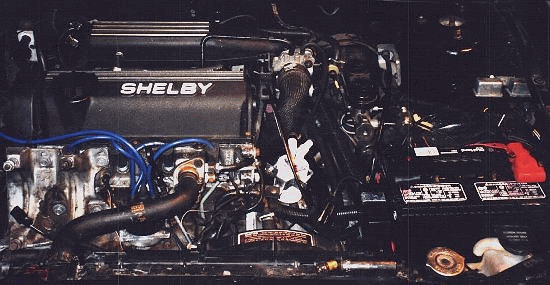
That white thing in front of the Turbo I turbocharger outlet hose is an oil catch canister that I have on all my cars. It keeps oil out of the airbox, but in this case, it is venting to the atmosphere. It's made out of PVC pipe parts and I plan on making a web page for it. I have improved the design well beyond this one, it was just lying around from the days of my Sundance. Obviously, the CSX has no A/C right now, but I plan on installing it over the summer. You might recognize the radiator; it's from the Shadow ES before it was intercooled. The wires are Splitfire Dual Coils. I have no love for Splitfire, and I have never used their worthless plugs. However, these were on sale for half price, so I grabbed them since they seem to be made very well. If they act up, I'll pitch them for Magnecores.
The CSX: September 15, 1998
Posted on September 15, 1998.
In early September of that year, I finally had the time to tear apart the engine to see what was going on. As I disassembled the intake ductwork, I was disgusted to find that the PCV vent line was tied directly to the intake duct, just past the air filter. The large amount of blow-by from cylinder #4 blew oil through the PCV system, through the intake, the turbo, up through the intercooler (!), and into the intake manifold. Most of it ran back into cylinder #4, causing it to burn all this oil. When I pulled the head, I found that the headgasket was fine, the #4 piston was fine, and there were no cracks in the head or block. I expected to see a whole in the piston from all of this blow-by. When I disassembled the head, I found that the exhaust valves guides were worn, but the rest of it looked OK. The head had a multi-angle valve jobs done at some point, so I decided not to mess with the valves and just grind them. After grinding, the valves seated very well, and I decided not to worry about the somewhat worn valve guides. There was no indication of the valve stem seals leaking, but I replaced them anyway. Cylinder #4 was carboned up really bad from the oil, as was #1. The only possibility left was the rings. When I pulled the pistons, I found that the upper ring on #4 was broken is six places and a huge chunk of the ring land was gone. The sides of the piston was badly carboned up from being driven this way for so long. Luckily, there was no scoring on the cylinder wall at all. The ring pieces were held in the piston by a nice coating of carbon.
I was very surprised to see that the block had almost NO wear. There no ridge at the top of the bores, either. I decided to deglaze the bores just to see how it would go. The first few passes with the honing tool showed the bores to be very even. A slight ridge appeared at the top, then disappeared a few passes later. #4 had a small spot where the piston must have been slapping, but it disappeared as well. I re-measured the bores and they were still straight and round. I then made several performance decisions with the help of a few people from the SDML (thanks to Gus, Neil, Dempsey, and Garry). Here are all the parts I ordered for this engine:
- Venolia pistons: 3.4430 diameter, 14cc dish (thank you Chris)
- Full-floating 0.936" Ford floating wrist pins and spiral-lock retainers from Venolia
- Turbo II rods from Forward Motion
- Rod bearings and piston rings from Mopar
- Lash adjusters from Perfect Circle
- New turbo oil and coolant supply lines
- Fel-Pro headgasket
Here is a shot if the pistons and rods after they had been balanced and the rod ends were modified to hold the larger pin. Pretty pistons, eh?
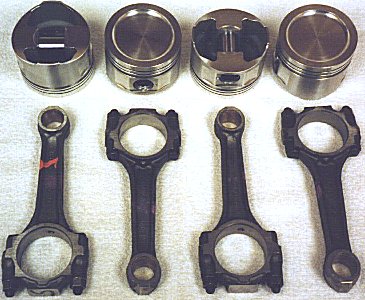
Along with all that, I replaced all gaskets and seals as well as the radiator and heater hoses, fuel lines, and vacuum lines. I also had to repair all of the wiring harnesses under the hood because of heat damage. The Venolia parts took two months to arrive. So, while I was waiting, I got ready for some future performance enhancements. Here are the parts I collected:
- ND Performance 3-bar computer set to 16psi.
- Fel-Pro 0.020 inch "Head-Saver" head shim to reduce compression to about 7.8:1
- K & N Universal Round filter to fit perfectly on the turbo inlet (RU-0640)
- Conquest intercooler (early version)
- 1st generation Talon BOV
- A bunch of 2 1/4" exhaust pipe and truck radiator hose
- My own, custom PCV breather and oil collector
I planned NOT to use the ND Performance computer at first. I decided to run with the stock CSX computer and the 804 injectors to take it easy on the engine and make it run rich, which is good for break-in. I would also plug the wastegate actuator can right on the manifold pressure to keep boost very low for the first couple of hundred miles. I would be saving the Conquest intercooler installation until the next summer, so I just used the turbo outlet hose from my '88 Turbo engine to run the engine as a Turbo I, since I had moved the stock Turbo II components to my '88 Shadow ES.
The CSX: August 21, 1998
Posted on August 21, 1998.
After search through several boneyards, I found a few of the interior pieces I needed, but the main panels were impossible to find because I needed to find a 1987 or early 1988 Shadow or Sundance with a dark grey interior (because of the seatbelt arrangement). This interior is somewhat rare. Nevertheless, the SDML came to my rescue. A great guy by the name of Arlie Hart found a Shadow sitting in a boneyard in NY with the interior pieces I needed. Trying to get those large panels shipped from NY to IL was quite a trick, but we managed. I also restored the majority of the wiring, which was severely hacked for previous stereo installations, and repaired the Boston Acoustic crossovers (power resistors) and replaced one of the tweeters. I then made up and added the necessary wiring harnesses for power windows, power door locks, and power mirror, which I intend to add at some point.
When the Shelby sat out in its first rainstorm, I was greeted the next day with water in the trunk and under the carpeting up front and in the back. The trunk leak was just the standard P-Body trunk leak issue, but the water in the front was from the windshield seals. In fact, most of the seals, weather stripping, etc was all falling apart after being in the intense heat of California. It look a long time to track down all the leaks and make the car sound again.
The CSX: July 31, 1998
Posted on July 31, 1998.
The CSX was delivered to me on July 31, 1998. The car carrier that had the car loaded took forever to deliver it because of mechanical troubles. The stories they told were so crazy that I was actually believing them and when the car arrived, the driver showed me what happened to his rig: blown tire rim, new hydraulic pump, and blown hydraulic hoses. I washed the hydraulic fluid and dirt off of it, and it looked to be in good shape.
- 1987 Shelby CSX #694
- 104,000 miles
- Mopar Performance Stage II Computer
- 804 Injectors
- Very Large K&N Cone Filtercharger
- 2-1/4 inch aluminized mandrel-bent exhaust with high-flow cat and no muffler
- Shadow ES interior (not complete)
- Sony CD receiver head unit
- Boston Acoustic speakers (blown crossovers)
Recent Repairs:
- New hood and fender
- Repainted roof, hatch, air dam and ground effects
- New timing belt
- New hoses
- New ignition wires
- New fuel filter
- New left front wheel bearing
- New hall effect sensor
- Recored radiator
- Rebuilt alternator
- New tires (Pirelli P700-Z)
Problems:
- Low compression (35 psi) in cylinder #4
- Bad A/C compressor clutch and no freon
- Minor chips in paint along the passenger door and the hood
- Paint on the trim around the windows was badly oxidized
- Bumper and ground effects were not properly secured
- Weather stripping around windows was falling apart
- Broken speaker grills
- Missing hatch security panel
- Drooping headliner
- Bad hatch struts
As you can see, the car had quite a few problems, but I knew about most of them before I even bought the car because the seller was very straight with me. It was still a good deal though (would have been better if I didn't have to pay for transporting it), and I was looking at it as a project car anyway.
The short ride home was a blast. The engine pulled hard, even though it was on 3-1/2 cylinders and the 2.5" no-muffler exhaust sounded great! The interior was pretty dirty and was missing quite a few of the ES interior pieces and the ES headliner was already falling down. I didn't have time to work on the engine right away, but I did start to fix many of the interior issues.

