
A dusty little corner of the Internet: electronics, computer hardware and software, general aviation, 1980's Mopars, and related sundry.
Computing
Keyboards
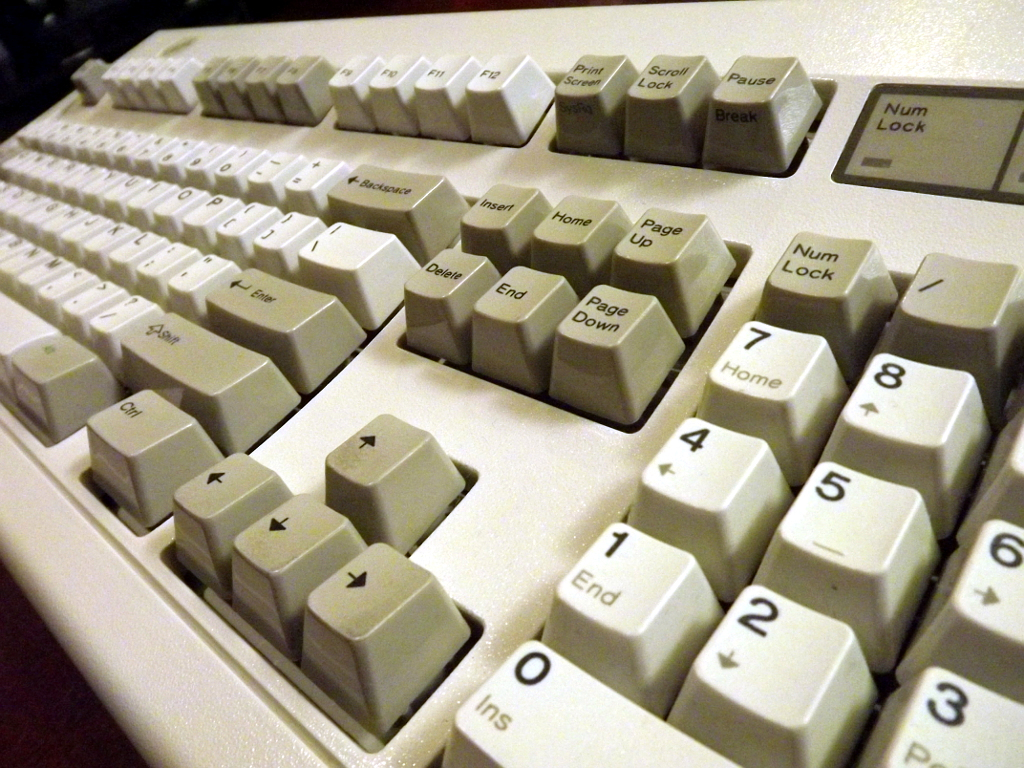 Some years ago I discovered that I am not alone in my obsession with mechanical computer keyboards. In fact, there are some people that are even crazier than me. I'd been using an IBM Model M buckling-spring keyboard at work for many years, which I'd bought brand-new in 1994 at a local electronics store. It's a joy to type on, but a bit too noisy for use at home. At work, I've only received a few threats. ;) Those were quelled by appying the "Model M grease mod", which softens the sound.
Vortex Race
Posted on August 09, 2012.
Here is the infamous Vortex "Race" 75% back lit keyboard. I've been using a KBC Poker X (a 60% keyboard) for a while with my laptop, so it is nice to have a real Fn row and a nav cluster of sorts. One has MX reds and the other MX browns. One or both will be "ergo-clear" modded at some point (MX clear stem with a blue/brown/red spring).
Here is the back lighting in action. It lets you set the brightness and lighting mode. One lame thing is that it forgets all the settings whenever it is reset. Another disadvantage is that it uses non-standard key cap sizes and profiles. So even if you give up the back lighting, you can only get other cap sets from Vortex. Vortex is a poorly-run company and I recommend avoiding working directly with them. Getting these turned into a bit of a mess over on GeekHack. The best thing is to buy them from a retailer that has them physically in stock.
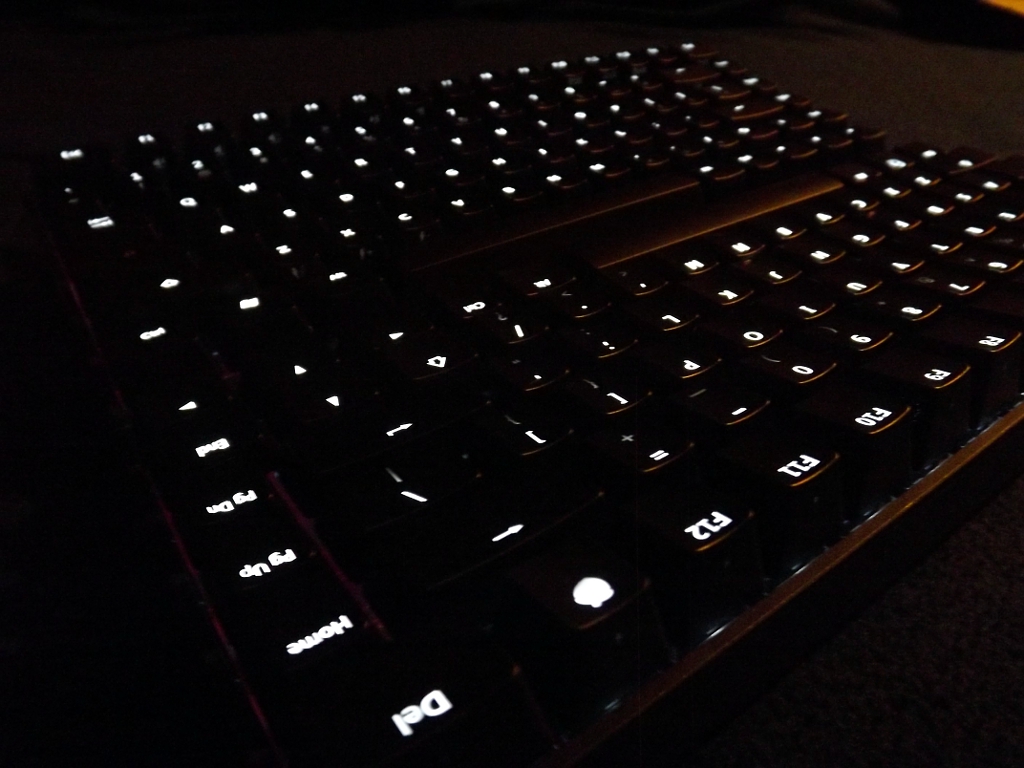
Both have white LEDs.
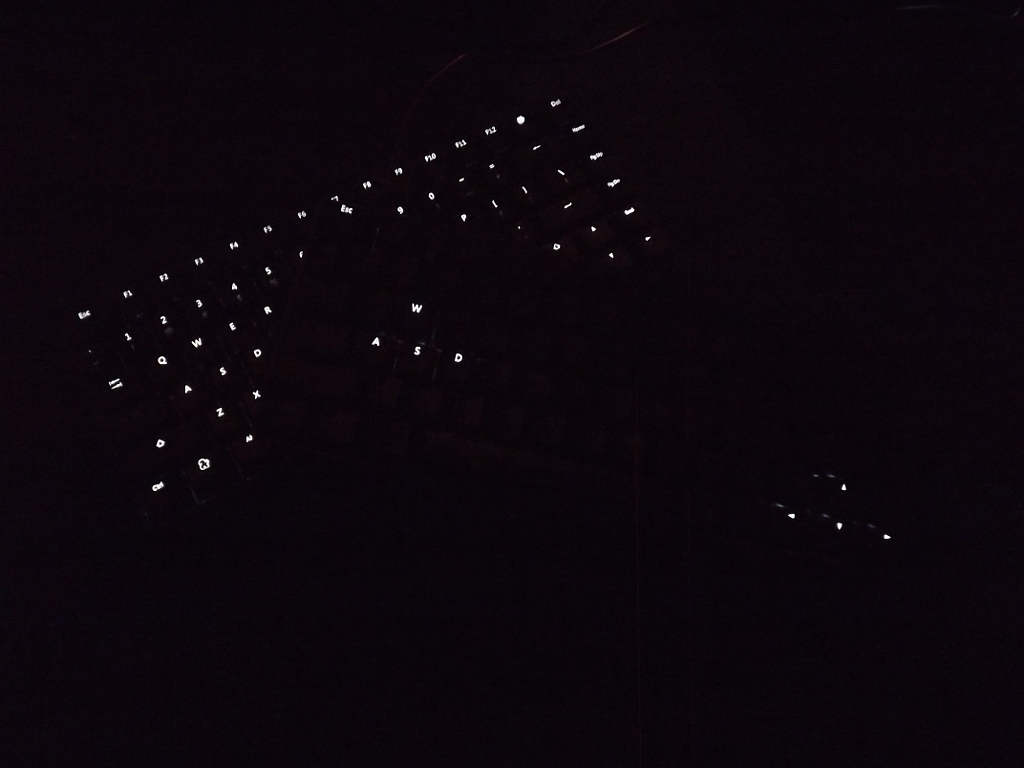
Full lighting and WASD/Nav lighting.
Reds on Reds
Posted on April 25, 2012.
This is the CM Storm Quick Fire Rapid with Cherry MX red switches sporting double-shot "Ragnarok Red" key caps from signature plastics. Much better than the gaudy caps it comes with. They have more texture to them, too.
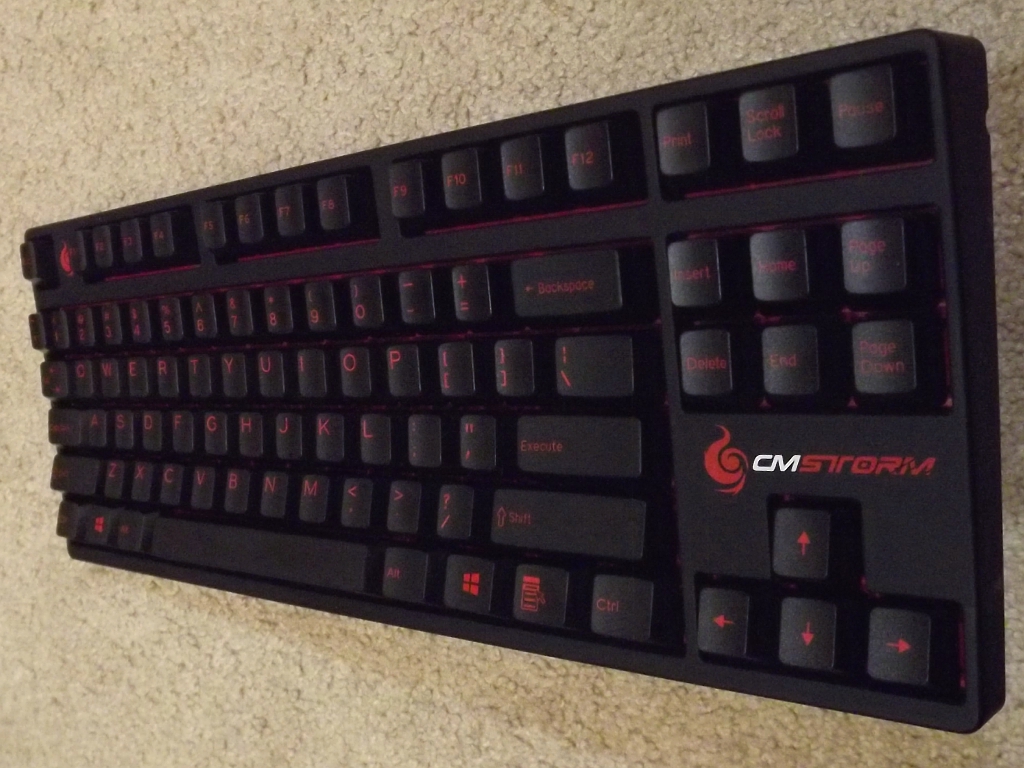
Perfect for the CM Storm.
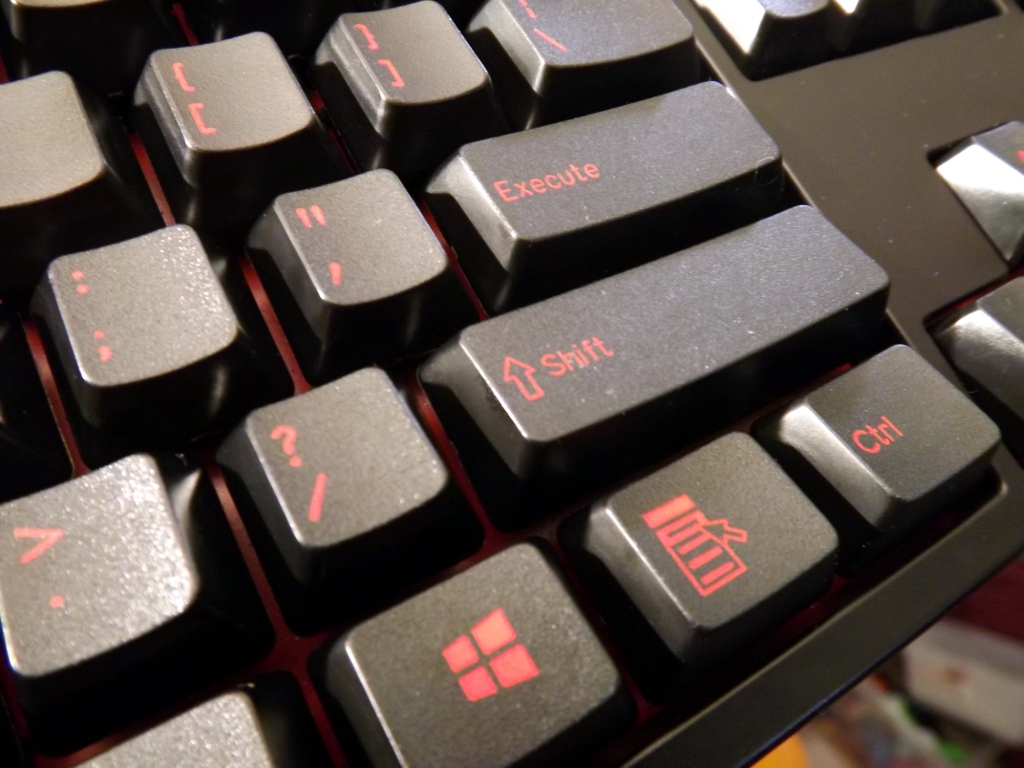
Close up on the Rosewill.
Model M Cracked Frame Repair
Posted on April 06, 2012.
This was originally posted on GeekHack in the mods section before we were attacked by r00tworm. I'll be moving it into the new Wiki at some point.
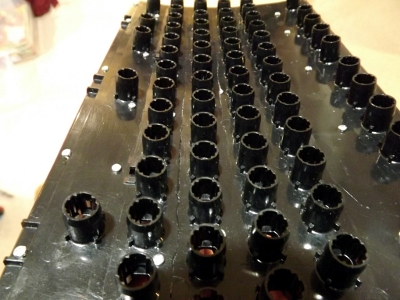 One of the Model M failures that is harder to deal with is cracking of the plastic plate that contains all of the key cap cylinders. Unicomp refers to this as the keyboard "frame". Severe cracking is usually caused by extended use with broken rivets and/or severe abuse. Between each row are channels where the plastic is thin so that the frame can follow the contour of the backplate. The plastic gets brittle over time and will crack along these channels.
Your choices for dealing with frame cracks are:
-
Find a different keyboard and use this one for parts.
-
Do a bolt mod and swap the frame from another good keyboard. This only makes sense if you have a good donor and the one you are fixing is more vintage or otherwise has some nostalgic value.
-
Get a replacement frame from Unicomp. This still requires a bolt mod, but they will sell you the frame for $10. I assumed that they only stocked the full sized frames, but I was wrong. They have 84 key frames in stock. (hmmm...why would they have those?)
-
Attempt to repair the cracks.
The keyboard I was repairing was a Model M Space Saving Keyboard (SSK), so the only option I thought I had was #4. I later bought a new frame from Unicomp, but only after I did the crack repair. I can't tell if the new frame is old stock or if it's a brand-new part.
Testing revealed that the frame is likely made out of ABS. This makes it a good candidate for gluing, as lots of solvents can cut ABS. Regular model cement usually has MEK in it, making it an easy choice. There are other, more aggressive glues out there as well that work well with ABS. You can also bond ABS with just solvent, but this is tricky as it requires a good fixture to hold everything together. The result is sometimes more brittle than when using a glue that has a filler, like model cement.
My plan was to cut some long, narrow strips and glue them to the top of the frame along the cracks. There is plenty of gap between the top of the frame and the bottoms of the key caps. This turned out to be unnecessary. All you'll need besides the usual nut-and-bolt stuff is a tube of model cement (the stuff you glue plastic models together with). It should be easy to find at a hobby or hardware store. Here are the steps that I followed:
-
Follow the usual procedure for the "Nut and Bolt Mod" and stop after you have driven all of the screws into the frame. Be extra careful while handling the damaged frame.
-
Now test fit the frame to the backplate. Leave out the membranes and rubber mat. You might want to lay a piece of wax paper down over the plate to keep the glue from sticking to it in step 5. I didn't have any issues, but it's something I thought of afterwards. Spin a few nuts on along the center and the corners to make sure all of the screws line up well. Check that the frame is following the contour of the plate. Look at the cracks and try to get the plastic aligned again so that the top is even. Usually one side of the crack will be above or below the other. Some pressure will pop them back in place.
-
Once you are happy, remove the backplate again and set the frame face-down. Be ready to reassemble them quickly.
-
Lay down a bead of model cement into each channel between each row, completely filling them. Keep it neat. Don't get any glue in or around the area where the pivot plate sits. Don't fill the channel higher than the adjacent ridge or it will squirt out. I did this to all of the channels, even the ones that hadn't completely cracked yet.
-
Reattach the frame to the plate as you did in step 2. Add as many nuts as needed to make sure the frame is following the plate contour snugly, especially around areas of severe cracking. Be sure to check the cracks to make sure the plastic is still aligned. Pop them back into place as necessary.
-
Once you are happy with it, set the assembly frame-down and leave it for 24 hours. The glue normally dries quickly, but it takes longer when it can't breath well.
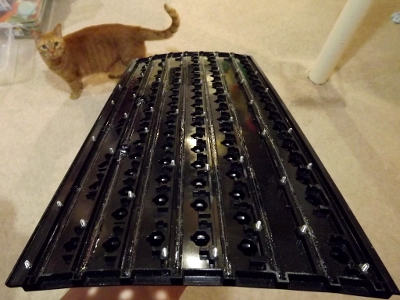
This is after the glue dried. Kitty finds the result to be satisfactory.
- The next day, remove the frame from the plate and check your work. The glue will shrink some as it dries, so you shouldn't have issues with extra glue sticking out. If you do see glue where it doesn't belong, it can be cut back with an exacto blade and smoothed-out with a paper towel dampened with acetone or MEK (wear gloves). Be careful not to get solvent where you don't want it.
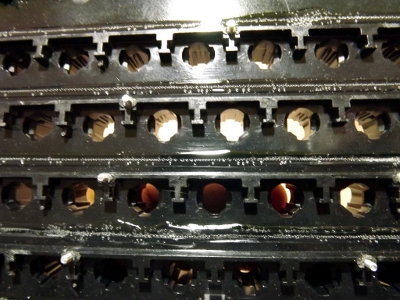
- Continue the Nut and Bolt Mod procedure from where you left off. It's a good idea to test it with a few nuts in place before completely finishing the reassembly.
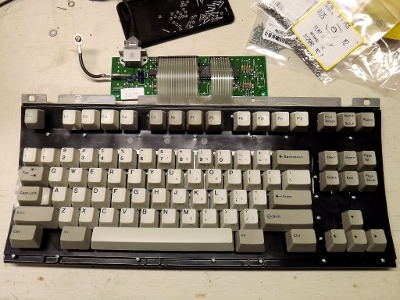
I was so impressed with how strong the frame was after doing this that I didn't bother gluing any strips on the top. The reassembled SSK is working well!
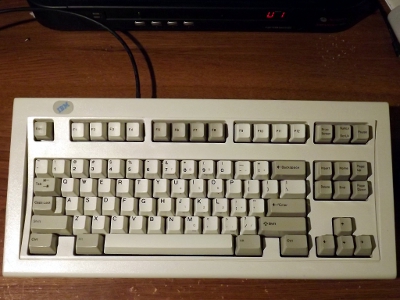
Below is a picture of the new frame from Unicomp. You can see that it has drain channels; something my '93 SSK lacks. Apparently, these are brand-new parts.
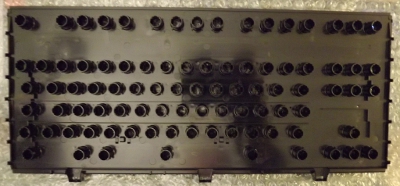
Even though Unicomp does not stock plates, membranes, or cases for the SSK, they do stock these. I'm guessing it's because it's the most common SSK-specific part that fails. The SSK is one of the more sought-after version of the Model M, probably because of the popularity of tenkeyless boards these days. There is a project on GeekHack to revive the SSK using modified Unicomp parts.
Custom Keyboard from WASD
Posted on March 15, 2012.
Here is a custom keyboard from WASD. This is their V1 with Cherry MX red switches, their snap-on wrist rest, and "50A-R" o-rings. The o-rings reduce the key travel slightly and soften the landing. The slight bounce of the rubber o-ring gives the linear MX red switch a bit of tactility. It is actually a nice compromise between typing and gaming, though they are a bit too soft for me to type fast.
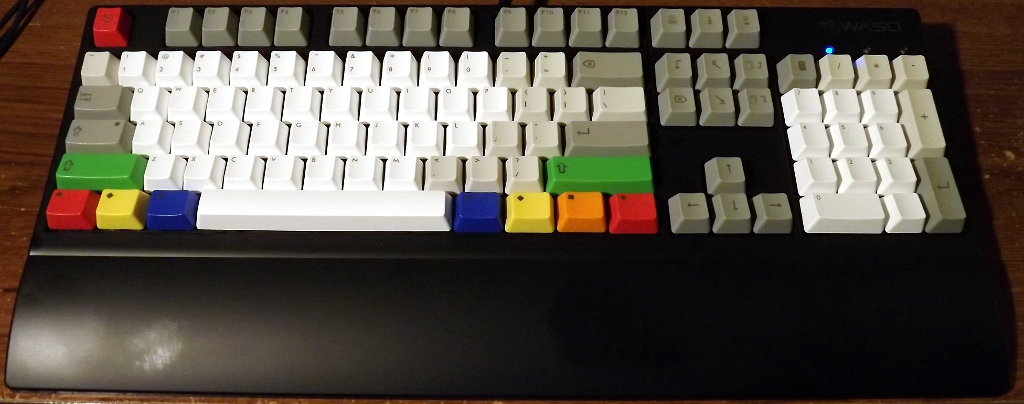
I used their custom keyboard designer, which allowed me to customize the colors and legends of the ABS laser-etched keys. They can also laser-engrave, which I did on the WASD cluster (very helpful, BTW). I went with all symbols on the modifiers. Unfortunately, they were out of dark-gray 1.25 unit modifiers at the time. I did the RGBYO thing, instead. A bit gaudy, but whatever. The Futura font is nice.
Rainbow of Cherries
Posted on February 15, 2012.
My search for a mechanical keyboard that will be quiet enough for home use and yet comfortable to type on led me to geekhack.org. Filled with copious amounts of information about modern production mechanical keyboards, I decided to give some a try. Most of them produced today use switches from Cherry Corporation's MX line. They use different stem colors to denote the different models. Mechanical keyboards have been coming back, thanks in large part to the gaming community. Four are commonly used switch types are:
- Blue - tactile with a audible click
- Brown - tactile with no click and lighter springs than the blue
- Black - linear with heavier springs than blue
- Red - linear with lighter springs (similar to brown)
There are lot of different brands out there with more coming all the time. In reality, there are only a few manufacturers making them. One of the best regarded, Filco, are made by Costar. Costar has been making boards for other brands using their reference design, which makes use of things like a steel plate that the switches mount to. In other words, you can get a "Filco" for much less than what a Filco-branded board costs.
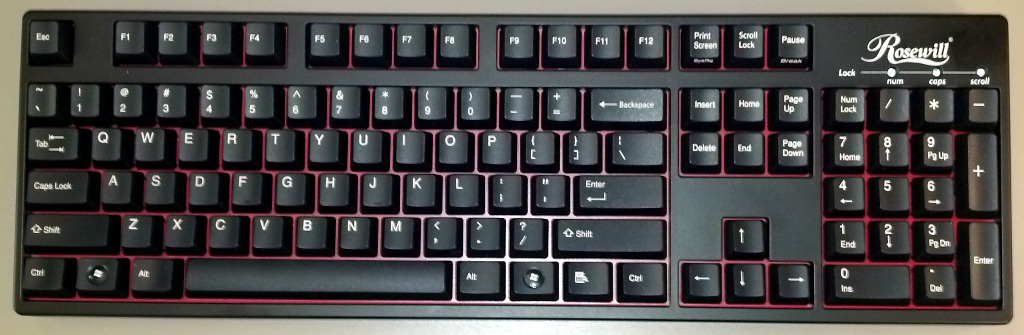
The MX Brown seemed the most logical one to try first. It was a quiet switch with some tactile feel. I opted for the Rosewill RK-9000, which has a full 104 key set. It's a very nice, solid board and I am extremely happy with it for typing. However, for gaming I found the tactile feel somewhat distracting. The bump in the stem that provides the feel also contributes a rough feel to the movement of the key.
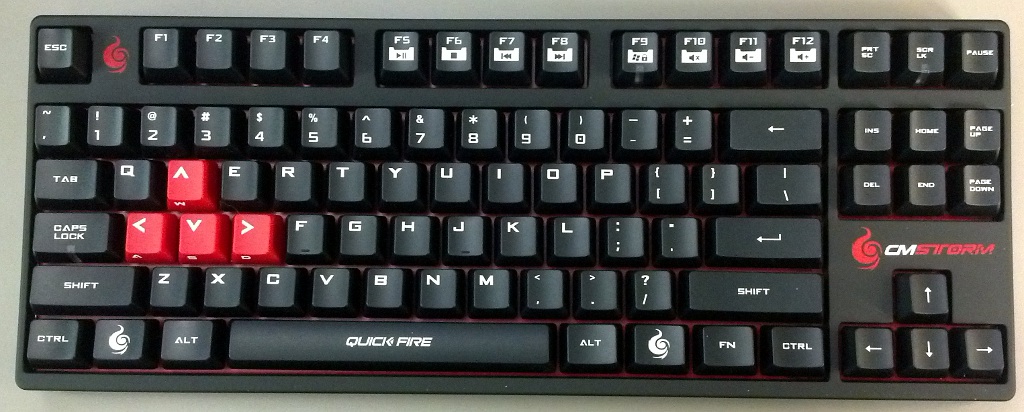
To address this, I picked up a CM Storm Quick Fire Rapid with MX Red switches. I find this to be much better for gaming. It's not quite as nice for typing, but it is still better than the previous keyboard I was using at home (Saitek Eclipse II). It is a "tenkeyless" model (no numeric keypad), which is a little weird at first. It's perfectly fine for gaming, though. It comes with some extra keycaps for the WASD and "super" modifiers. The overall look of the keycaps is somewhat obnoxious. However, it's still a Costar with a metal mount plate and all that. It is a solid board that just needs some better caps.

